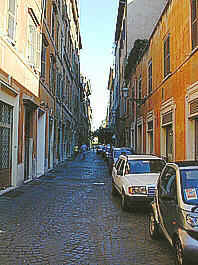
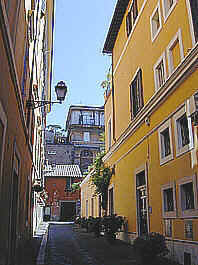
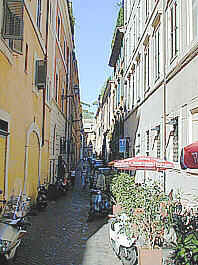
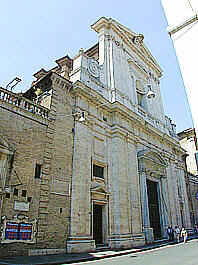
Spanish Steps quarter: Via Babbuino area, Via San Giacomo, Via dei Greci, Via del Corso For a complete presentation, please visit the specific pages on the streets of the quarter: - Spanish Steps general
presentation
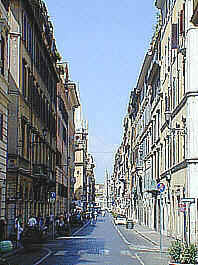
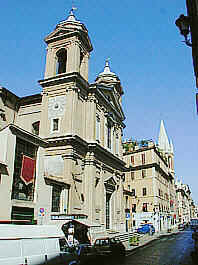
Via del Babbuino (Baboon street) connects the Spanish Steps with Piazza del Popolo and the northern gate of Rome. It owes its name to an ancient Roman statue situated near the Church of St. Attanasio, at half-way of its length. The statue is warned-out, and the Romans, with their great witty personality dubbed it "the baboon", because it was ugly. Today it is part of a fountain, and it is one of the "talking statues" of Rome. Whoever has something to say, or someone to insult, will write a graffiti, or leave a written message. The Church of St. Atanasio is a Greek-Catholic church, i.e. the priests are Catholic, but they follow the oriental rite, and they can marry.
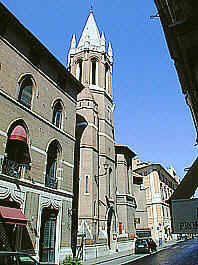
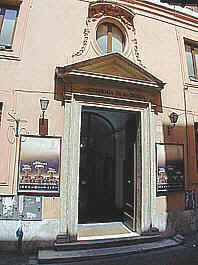
Just after it you find one of the two Anglican Church in Rome, St. Patrick. The little streets intersecting the Via del Babbuino are famous, although they have a different personality. Via dei Greci is renowned for its antiquaries, for the Lyon Bookshop (the oldest English bookshop in Rome, and for the famous Musical Academy of Santa Cecilia. Via Margutta is famous for its artists' and painters' studios.
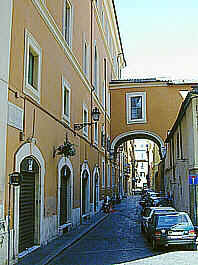
Via Orto di Napoli is known for its charm, Via San Giacomo, where circulation is forbidden (cars can only park), has a very special feel for its quiet and its mannerly palaces. Luckily, it includes also a grammar school, with only a few students, which make it somewhat lively in certain hours of the day. The street brings to the Church with the same name (San Giacomo) in Via del Corso.
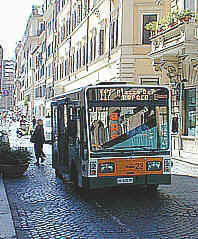
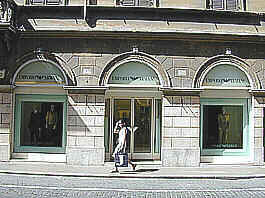
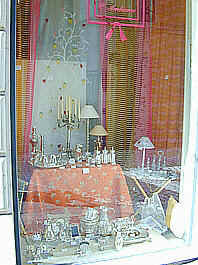
Two electric buses drift among tourists in Via del Babbuino. They are 117 and 119, and are very convenient to go to a number of destinations (Piazza del Popolo, the Borghese Gardens and Museum, Via del Corso, Piazza Venezia, Capitol Hill, the Roman Forum and the Monti quarter. There are countless shops in the area, notably antiquaries, art studios and galleries, and jewelers.
Many famous Italian composers studied at the Musical Academy of Santa Cecilia in Via dei Greci / Via Vittoria.
|